

Mortgage underwriting has been one of the slowest and most error-prone parts of lending for decades. . Every delay costs brokers time, borrowers’ patience, and lenders’ money.
The industry is now making up for the lost time. With automated underwriting systems, approvals that once took days can happen in minutes. A report by McKinsey found that intelligent process automation can reduce overall mortgage processing time by 50-60%, while another study indicates that automation can lower processing costs by 40%. For brokers, that translates to less paperwork, faster closings, and fewer sleepless nights waiting for an approval to land in the inbox.
What is an Automated Underwriting System
An automated underwriting platform is software that automates key underwriting tasks, such as document validation, rule checks, risk scoring, and income verification. Its value lies in quickly moving data through the underwriting process with very little manual effort.

Recent research by the Federal Reserve Bank of Philadelphia found that machine-underwritten loans had a default rate 6.8% lower than human-underwritten ones, reflecting improved consistency and risk selection.
The stat shows why brokers are shifting their workflows and adopting technology, specifically advanced automated mortgage underwriting solutions like Expert Mortgage Assistance (EMA).
Why Brokers Should Care: Speed, Accuracy & Visibility
In the old mortgage loan process timeline, underwriters manually reviewed documents, verified income, and ran compliance checks. That often stretched timelines and drained resources. With document automation for underwriting, brokers can compress that timeline, reduce errors, and provide borrowers with clear visibility.
For example, after implementing automated underwriting, a major lender reduced turnaround time to under 48 hours and cut operational costs by nearly 50%. In practical terms, that means fewer days stuck in underwriting, fewer callbacks to borrowers, and happier clients.
Moreover, with dashboards and real-time updates, brokers can track progress across every module. A transparent underwriting process automation system supports investor or lender demands for audit trails and consistent decisions.
Core Components of an Automated Mortgage Underwriting Platform
To see how this fits into your broker workflow, here are the key capabilities of an automated underwriting system:
- AI loan underwriting & risk scoring: Algorithms evaluate borrower data, credit history, property info, and run it through approval guidelines.
- Document automation for underwriting: OCR, extraction, and validation of pay stubs, bank statements, and property appraisals.
- Automated underwriting solution decision engine: Applies lender’s approval guidelines and policy logic so decisions are consistent and auditable.
- Integration with processing platforms: Feeds into the mortgage loan processing workflow, and connects the broker, processor, underwriter, and closing team.
In effect, brokers who adopt a unified automated underwriting platform connect the processing team with the decision engine for smooth handoffs.
The market supports this trend: according to Allied Market Research, the global underwriting software market (which includes mortgage-application use cases) was valued at approximately USD 5.7 billion in 2023 and is projected to reach USD 15.9 billion by 2032 — a CAGR of around 12.5%.
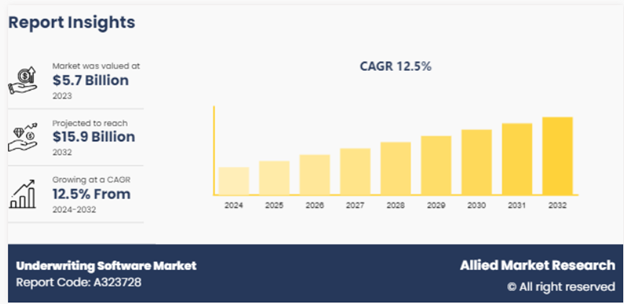
This growth signals that lenders, servicers, and brokers see value in this transformation.
How Underwriting Process Automation Improves the Broker’s Workflow
To understand how these capabilities translate into real impact, let’s look at how an automated underwriting system and underwriting process automation simplify each stage of a broker’s workflow:
1. Borrower submits application and documents
The process starts when the borrower uploads their loan application, income proofs, and other documents directly into your platform.
2. Automated data extraction and validation
The automated underwriting platform instantly reads and verifies borrower data, including income, assets, credit reports, and employment details, reducing hours of manual checking.
3. Intelligent decision processing
A decision engine applies your predefined approval guidelines, such as loan-to-value (LTV), debt-to-income (DTI) ratios, and property type. Based on these rules, it issues instant recommendations like approve, refer, or deny.
4. Human review for exceptions
If the decision is “approve” or “refer”, underwriters step in only to review exceptions or edge cases that need human judgment. This keeps skilled resources focused where they’re needed most.
5. Automatic logging and handoff to closing
Every decision is recorded in real time. The automated mortgage underwriting software stores audit trails for transparency and compliance before the file moves to the closing stage.
Here’s a sample table showing typical efficiency gains:
| Stage | Manual workflow | Automated workflow | Time saved |
| Document verification | 1-2 days | ~1 hour | ~90% faster |
| Underwriting review | 3-5 days | ~1 day | ~75% faster |
| Compliance validation | 2 days | Real-time | ~100% faster |
| Total loan processing | 45-60 days | 25-30 days | ~40-45% shorter |
The gains come not just from speed but from predictability and scalability. Brokers can handle more volume without incurring proportional costs.
The Role of AI Underwriting for Banks and Commercial Loans
While much of the discussion focuses on residential mortgages, the same principles apply to AI commercial loan underwriting and large-scale lending. Technologies built for banks are now accessible to brokers and lenders with smaller portfolios.
By using machine-learning models layered into automated mortgage underwriting software, lenders can perform nuanced risk assessments for multifamily, office, or mixed-use properties.
The brokers that handle diverse loan programs, integrating AI loan underwriting or a commercial counterpart, add differentiation and flexibility. In all cases, automation frees up the underwriter to focus on unique or high-net-worth cases, rather than routine reviews.
How Brokers are Using Underwriting Process Automation + Outsourcing to Scale
The ideal workflow combines internal teams + external support + technology. That means brokers partner with specialized services while leaning on platforms that deliver processing and underwriting automation.
By integrating mortgage support services into this architecture, brokers gain access to trained staff who handle data entry, verification, and condition management, while the automated system handles rule checks and rapid decision-making.
Similarly, outsourcing part of your mortgage loan processing workload allows you to scale without hiring more full-time staff. And for routine tasks, firms can deploy mortgage virtual assistance to supplement internal teams.
That integrated stack, i.e., automation + virtual support + human oversight, supports the entire underwriting lifecycle without sacrificing quality or compliance.
Real-World Results: How Automation and Outsourcing Work Together
A top U.S. residential mortgage lender was facing long underwriting timelines and growing backlogs. Average loan closures stretched to nearly three months.
Expert Mortgage Assistance (EMA) stepped in with a dual strategy, combining automated underwriting solutions with offshore processing support. Routine tasks were automated, while EMA’s trained offshore team handled exception management and daily turnaround reporting.
Within weeks, results were clear:
- Loan closure time dropped by 40%
- Operational costs fell by 40%
- Underwriter efficiency improved significantly
- The lender doubled its loan-handling capacity
By blending automation and human expertise, EMA helped the client move from bottlenecks to speed and scale, showing how technology-powered outsourcing can change mortgage underwriting efficiency.
Addressing Common Challenges When Adopting Underwriting Technology
While brokers are clearly gaining speed and efficiency with automation and outsourcing, the shift doesn’t come without friction. Moving from manual reviews to underwriting process automation introduces its own set of challenges.
Here’s what most brokers encounter when they start modernizing their underwriting process:
- Data integration – Legacy systems may not feed smoothly into the automation engine; workflows must be remapped.
- Policy alignment – Your approval guidelines must be translated into rules within the system, and those must be maintained over time.
- Underwriter adoption – People may resist change. Training underwriters to shift from doing manual reviews to exception handling takes time.
- Compliance and auditability – Automation doesn’t remove responsibility. You must still prove decisions and keep transparent logs.
Yet the reward is worth the effort. When you embed automated underwriting solution logic into your workflow, you stop reacting to document conditions and start controlling the pipeline proactively.
What This Means for Borrower Experience & Broker Differentiation
For borrowers, the difference is simple: faster approvals, clearer status updates, fewer requests for missing items. Automated workflows eliminate many of the frustrations of the old mortgage application process timeline.
From a broker’s viewpoint, adopting automated mortgage underwriting software becomes a competitive advantage, i.e., reducing drop-off, improving turn times, and building trust with referral partners.
With borrowers accustomed to instant digital experiences, your underwriting back-end must align. Technology ensures your front-end promise becomes a delivery reality.
Ready to increase loan approval rates up to 40% with EMA? Contact us now.
FAQ
1. How is technology changing mortgage underwriting for brokers?
Technology is shifting underwriting from manual reviews to rule-based automation, accelerating approvals and increasing consistency.
2. How does automated underwriting improve loan processing speed?
Automated underwriting improves loan processing speed through intelligent data handling. These systems extract borrower details, validate documents, assess credit and risk scores, and route files for approval within minutes, reducing several days from the traditional underwriting timeline.
3. What are the benefits of AI in mortgage underwriting?
AI improves risk assessment, reduces human error, offers consistent decisions, and supports higher application volumes.
4. What challenges do brokers face when adopting underwriting technology?
Challenges include data mapping, integrating legacy systems, aligning policy rules in software, and training staff on new roles.
5. How does digital underwriting improve borrower experience?
Borrowers receive faster feedback, fewer condition requests, and transparent status updates, raising satisfaction and loyalty.
 Prev
Prev