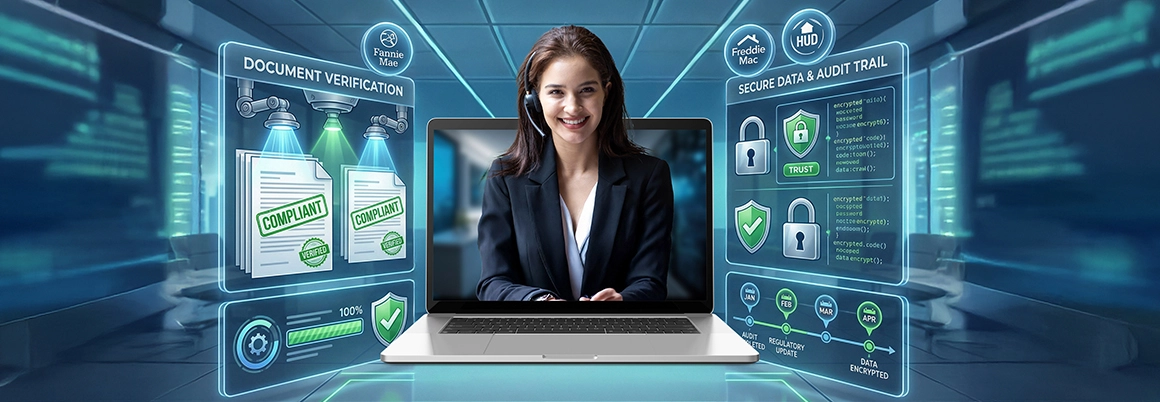
Risk as a function operates very differently today than it did a decade ago. Mortgage cycles have tightened, data requirements have multiplied, and borrower expectations for speed leave little room for operational friction.
Here are a few reasons compliance risk remains difficult to control:
- Regulations change frequently, often without long lead times (At a recent Mortgage Industry Roundtable by PerformLine, nearly 54% of participants expressed regulatory changes as the biggest challenge),
- Lenders must keep up with scrutiny at the federal and state levels simultaneously,
- Mortgage operations rely on an interconnected ecosystem where LOS, third-party systems, and multi-team workflows must move in sync,
- High volumes and tight deadlines increase the chance of missed disclosures, delayed documents, and inconsistent communication.
In this environment, a mortgage virtual assistant is becoming an essential support that helps lenders stay on-time and compliant.
AI is now playing a bigger role in reducing this friction, especially when combined with trained human support. This is why many lenders are turning to AI-powered virtual mortgage assistants, as they bring consistency to processes that typically break under volume pressure. In the following sections, we’ll look at why these AI VAs have become a necessity for modern mortgage operations.
How Virtual Mortgage Assistants Solve the Most Common Compliance Challenges
When lenders pair trained humans with AI-enabled assistance — such as Expert Mortgage Assistance’s virtual mortgage assistants — they create a multi-layer workflow where key touchpoints aren’t skipped, documentation stays clean, and operational burden doesn’t sit entirely on internal teams.
Below are the core compliance risks lenders face — and how virtual support helps keep them under control.
Lien Releases and County Recording Compliance
For lenders, lien release compliance involves managing a set of moving parts where even a small oversight can turn into a regulatory or investor issue. Cross-collateralized loans, historical payment documentation, release confirmation trails, and county-specific submission requirements all demand accuracy. When volume spikes or multiple states are involved, the risk of incomplete release packets, missing logs, or inconsistent communication becomes much higher.
This is where trained virtual mortgage assistants bring real value. They track county requirements, maintain submission logs, and flag missing documents before deadlines. They also maintain communication records, verify supporting documents, and cross-check payment histories to reduce errors.
These responsibilities overlap naturally with the services of a virtual mortgage loan processor, especially in environments where high origination volumes and operational constraints create more opportunities for compliance gaps. Behind the scenes, lenders often rely on mortgage virtual assistant services that handle document verification, borrower communication logs, regulatory checks, CRM updates, and coordination tasks that keep lien release workflows intact.
Fair Lending Alignment
Fair lending risks often stem from communication gaps, inconsistent follow-ups, or improper documentation. There’s also the case of algorithmic bias that can arise when systems rely on incomplete or unverified data. Unless the operational workflow is solid, there are higher chances of risk exposure. Lenders must consider legitimate credit factors, detect disparities early, and maintain uniform borrower treatment.
Recently, state-level scrutiny has also intensified. As federal agencies adjust enforcement priorities, state regulators are picking up the slack — and many former federal enforcement attorneys have moved into state roles, strengthening their capabilities. In this environment, companies are better off maintaining strong fair lending compliance systems rather than waiting for the next wave of enforcement.
This is where mortgage virtual assistants help. They standardize borrower communication, ensure consistent follow-ups, and document every interaction — reducing the risk of perceived or real disparate treatment. They also help maintain complete borrower files, which becomes crucial when lenders need to demonstrate fair and equal processes during audits.
A mortgage broker virtual assistant keeps communication templates, timelines, and documentation practices uniform across states, ensuring every borrower receives consistent treatment without gaps or unequal attention. This consistency becomes even more important when teams rely on virtual assistants for mortgage brokers’ support to handle fast-moving borrower pipelines.
Fraud Detection
In Q2 2025, about 1 in every 116 mortgage applications carried fraud risk, compared to roughly 1 in 123 the previous year. Fraud exposure often increases with application volume. Small inconsistencies can go unnoticed when teams are rushed, short-staffed, or handling data across multiple systems.
AI-powered virtual assistants help reduce this risk by running anomaly checks, spotting mismatched identities, flagging irregular documentation, and identifying patterns humans may miss. These checks become a force multiplier when combined with human review: the VA handles the constant monitoring, while teams focus on deeper investigation.
Such operational efficiency results in companies seeing a substantial reduction in fraudulent activities. This was the case with Expert Mortgage Assistance’s VA-driven verification workflows, which helped a large bank strengthen fraud prevention across its retail mortgage channel. The bank previously experienced extensive losses due to rising fraudulent activity, slow and error-prone data compilation, and frequent misses during manual verification. After integrating automated checks and data validation workflows, they achieved 24×7 monitoring, eliminated fraudulent application slips, and reduced loan risk review time by 80%.
RESPA Disclosures and Reporting
Regulations such as RESPA, TILA, and TRID are designed to protect consumers through clarity, fairness, and transparent disclosures — but lending teams know how easily these timelines can slip. Many touchpoints depend on cross-team coordination, borrower responsiveness, document availability, and system accuracy. A missing timestamp, incomplete disclosure packet, or inconsistent delivery log can quickly turn into a compliance issue.
Lenders also admit that operational challenges are weighing them down. In a recent CSI survey, 44% of respondents listed operational efficiency as their top strategic priority for 2025. And meeting that priority means eliminating the errors and delays that affect regulatory disclosures.
Virtual mortgage assistants track disclosure windows, monitor delivery timestamps, maintain documentation trails, and ensure nothing falls through the cracks. They support early disclosures, redisclosures, servicing transfers, and post-close documentation — helping lenders maintain timelines without straining in-house capacity.
Pre-Fund, Post-Closing, and Underwriting QC
QC cycles often break when documents arrive late, are stored inconsistently, or don’t match LOS entries. A strong QC process needs clean document packages, consistent naming standards, and complete file trails — something that can be difficult to maintain during peak volume.
A mortgage virtual assistant contributes by validating document completeness, cross-matching disclosures, and preparing files so they pass audits with fewer revisions. A fast-growing valuation company headquartered in Spring, Texas saw this firsthand. They were dealing with inaccurate reports from a previous provider, a strict turnaround deadline, and an increased volume that was nearly triple their usual load.
With the help of Expert Mortgage Assistance’s trained VAs, they implemented a QC checklist, built a team capable of 4–6 hour review cycles, and maintained 98% accuracy. This reduced lender revision requests, lowered operational costs by 40%, and brought turnaround times down from 24 hours to under 2 hours — a 79% improvement.
Data Accuracy and LOS Consistency
Manual data entry creates some of the most avoidable compliance issues. A single mismatch between the LOS and source documents can affect disclosures, underwriting decisions, and servicing transfers. This is why lenders rely on AI-powered VAs to compare LOS entries with source files, validate borrower data, and eliminate incomplete or inaccurate fields.
How Partnering with Expert Mortgage Assistance Helps Lenders Minimize Compliance Risk
Expert Mortgage Assistance’s AI-powered VAs operate on the principles of Poka-Yoke error prevention and the DMAIC continuous improvement framework. This combination keeps documentation accurate, reduces defect propagation, and ensures that minimized operational complexity increases compliance. Here’s how the system supports lenders:
Process-specific virtual resource allocation
Each task — from pre-underwriting reviews to borrower interaction logs — is handled by a trained specialist who understands the compliance implications of every touchpoint.
Document indexing and retrieval
Real-time labeling, structured naming, and automated checklist updates reduce missing disclosures and retrieval delays — three of the most common sources of audit findings.
Quick turnaround
By supporting the teams responsible for lien releases, settlement statements, and recording requirements, VAs reduce the chance of delayed or incomplete closing documentation.
Scalability during loan volume surges
When purchase seasons or refinance waves hit, EMA scales support without compromising onboarding timelines, reducing compliance cracks from rushed work.
Improved audit readiness and QC score
Before files move to the next stage, assistants verify notes, conditions, and documentation. This audit-first approach lowers repurchase triggers and deficiency findings.
Reduced data input errors
Assistants cross-check LOS entries against source documents, helping lenders reduce data inaccuracies — as much as 80% after implementation.
As a professional mortgage processing company, we offer a dependable, tech-enabled solution that blends human judgment with automation. With us, lenders are building a mortgage virtual back-office support that complements internal teams and aligns with mortgage back-office outsourcing goals. In short, with us, lenders can reduce compliance risk with trained virtual assistants while also strengthening operational consistency.
Strengthen Your Compliance Game
Compliance risk increases as lenders balance higher volumes with faster turnarounds. AI-enabled mortgage virtual assistant delivers stronger controls, cleaner files, and audit-ready operations without slowing production.
For lenders focused on leveraging technology to strengthen compliance, Expert Mortgage Assistance’s VAs deliver the precision and operational discipline you need. Contact us today.
FAQ
1. Do virtual mortgage assistants help with QC and underwriting compliance?
Yes. A virtual mortgage assistant can support pre-underwriting reviews, document verification, and QC checks to ensure files are complete and compliant before moving forward. This reduces errors, inconsistencies, and audit findings across the loan lifecycle.
2. Can I choose the type of VA support I need for my mortgage lending service?
Yes. Virtual assistant support is fully customizable based on your workflow, department, and compliance needs. You can choose VAs for tasks like processing, underwriting support, borrower communication, QC, or post-closing.
3. What happens if there’s a sudden surge in loan volume?
A mortgage VA team can scale quickly to handle seasonal peaks, purchase waves, or refinance spikes. This ensures your pipelines move without delays, missed deadlines, or compliance gaps. Expert Mortgage Assistance provides rapid scalability with minimal onboarding time.
4. How can a VA help in reducing repurchase risk?
A mortgage VA enhances file accuracy by checking document completeness, validating disclosures, and ensuring LOS data matches source documentation. This reduces conditions, deficiencies, and post-close findings that typically trigger repurchase requests. Expert Mortgage Assistance’s QC-driven workflows make this process more reliable.
5. Do virtual mortgage assistants help with fraud detection?
Yes. Mortgage VAs use AI screening tools, anomaly checks, and identity validations to flag irregular patterns early in the process. This helps lenders identify high-risk files faster and strengthen fraud prevention across origination and servicing workflows.
 Prev
Prev